
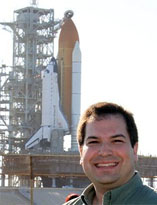
Craig with Atlantis at Launch Pad 39-A, the day before STS-132 (2010)
Since I am lucky to be one of 150 unofficial ambassadors selected to participate in a NASA tweetup during the final Space Shuttle launch later this week, I thought I would provide a little background on why I love all things space.
The Early Years
I can’t pinpoint exactly when I became interested in space, but the first memory I have of something space-related occurred in 1985, when I was six or seven years old and lived just outside of New York City. My father was overseeing the opening of a new site for his employer in Roanoke, Va., a wonderful city to which we would eventually move and in which I would live for 18 years. For several months before we moved, my father commuted to Roanoke during the week, and returned to New York each weekend. To remind my sister and me that he was thinking of us during his travels, my father always came back each week with a toy or souvenir that he bought for us. (I’m not sure if my mother got a gift every week, but one of the weeks he brought her back a diamond, so I think it averaged out.)

My first telescope, now displayed in my living room
To this day, I only remember one specific gift. I can still picture our family sitting in the living room, eagerly waiting for my father to open his suitcase and tell us about his trip that week. (To be honest, I was usually more excited about the former than the latter.) On that particular week, my father presented me with a small telescope. It was a Tasco 40×40 — not exactly Hubble, but still a great start for a pint-size astronomer. Plus, it incorporated the two attributes of a gift most sought after by every little boy — it was red, and it was shiny! I can still picture the box it came in, and I can still remember feeling like I had graduated from receiving a toy to be entrusted with something a little grown-up.
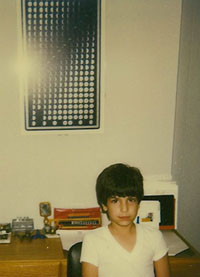
Poster showing phases of the Moon (1986)
I’d like to say that I could be found most evenings in the backyard, gazing skyward and studying the shimmering stars. That’s not quite true; in fact the telescope featured more into my bedroom decor than my field observations. But it was a constant reminder that there was a whole universe out there beyond what I could see at first glance.
About that bedroom decor… Once I settled into my new bedroom in Roanoke, my parents outfitted it with three huge posters, professionally framed in glass. One was a map of the Solar System, showing the relative sizes of the planets and their orbits. One was a tall pictorial table of the phases of the Moon. The third, my favorite, was a magnificent photo of America’s first Space Shuttle launch, as Columbia lifted into the air amid plumes of billowing steam. I looked at that photo every day, and every day I wondered what it must be like to witness such a sight firsthand.
(It didn’t occur to me for several years that the External Tank pictured on that poster was white, but all the other ones I’d seen were orange. I learned that NASA painted the orange tank white for the first two Space Shuttle missions to reflect heat, but stopped after determining that this wasn’t actually a problem and that the white paint added 600 pounds of unnecessary weight. The original orange color is the spray-on foam insulation.)
Rocket Dad
![[Photo of Gary Fifer]](http://www.fifer.net/blog/wp-content/uploads/Gary-Fifer_rockets_Feb-1966-large.jpg)
Gary Fifer (l) and friends Jeffrey Trauberman and Richard Schnoll model their rockets for The Bayside Times (Feb. 1966)
Another Family Connection
The posters in my bedroom were also accompanied by a framed 8×10 photo of the Space Shuttle lifting off behind the press site flag, taken by my great uncle, Arnie Sachs. Arnie was a distinguished news photographer in Washington, D.C., covering every important event in our nation’s capital for more than half a century. (His most famous photo captured the moment in 1963 when a young Bill Clinton met President John F. Kennedy at the White House.) But the news out of Washington was sometimes out of Washington, and Arnie began visiting Cape Canaveral to document America’s newborn space program after the surprise Soviet launch of Sputnik 1.
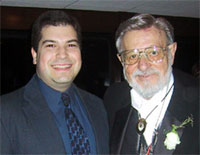
Craig with Uncle Arnie (2005)
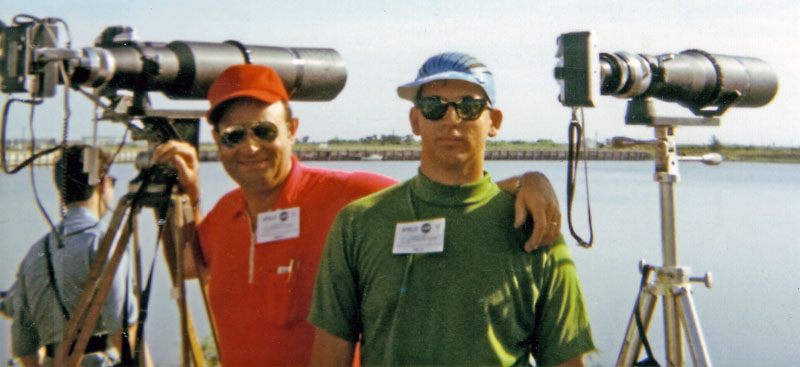
Arnie and Ron at the Press Site for Apollo 11 (July 16, 1969)
He was there on Dec, 6, 1957, for the first (and unsuccessful) U.S. attempt to place a satellite in orbit aboard a Vanguard rocket. He was there on February 20, 1962, to watch John Glenn lift into orbit aboard Friendship 7. He was there with his whole family on July 16, 1969, as the Apollo 11 mission launched towards a successful moon landing four days later. He was there on April 12, 1981, as America’s first Space Shuttle launch ushered in a new era of space travel. He covered the next half-dozen or so Shuttle launches, including Sally Ride‘s historic milestone as the first American woman in space.
Uncle Arnie had thousands of stories to tell, and I loved hearing every one of them. He had met so many amazing people, and seen so many amazing things, and all I had to do to feel part of those experiences was to ask him about them. Arnie passed away in 2006, but his legacy lives on through his children — particularly his son Ron, who is the current president of the White House News Photographers Association. Ron helped me fill in the details of Arnie’s connection to space for this post.
Innocence Lost
“It was in fourth grade, in 1986. The twenty-eighth of January to be exact.” So begins an essay I wrote for a 1989 creative writing class. The assignment was personal narrative, and I wrote about the Challenger tragedy. I recalled how my teacher, Mrs. Williams, tried to explain to us what had just happened. Thinking back now, I can imagine how many teachers — who just a few minutes earlier may have envied Christa McAuliffe‘s selection as the first teacher in space — must have reflected on the mysteries of fate.
As I documented in my essay but had forgotten until I read it just now, my principal came over the PA system and asked us to rise and recite the Pledge of Allegiance. It seems like a curious choice in hindsight, but I suppose it was the first expression of solidarity that crossed her mind. Perhaps she thought it would be helpful for us to cling to something routine, something solid. Looking back, I think it also reflected the degree to which the Space Shuttle had become — and still remains — a national icon as evocative as our flag. Challenger‘s mission that day was only the 25th in the Space Shuttle program — enough to feel comfortable that everything would go smoothly, but not so many as to dull our rapt attention at every launch. Challenger, like the flag, was instantly recognizable around the world as a symbol of America. When she and her crew perished, a part of America died with them.
My mother encouraged my sister and me to write a letter of sympathy to the family of Judith Resnik. As the first Jewish American in space, my family felt a special connection to her. But seven year-olds are not normally in the business of sending condolences, let alone to complete strangers. At first, I found the exercise uncomfortable. Slowly, as I’m sure my mother knew it would, the letter became a way to make a very abstract tragedy seem a little more real. For me, Challenger was something on TV and in the newspaper. But now I was writing to real people — people who had known Judy in real life. When we received a hand-written thank-you note from the Resniks, this connection became complete.
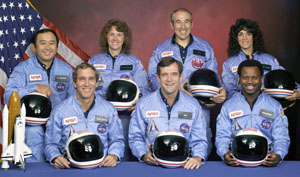
Crew of STS-51L (1986)
I also realize now that, since the Challenger crew was the first whose names and faces I ever learned, there’s never been anything surprising to me about the idea of an astronaut being a woman, or Asian, or Black. I can thank the crew of STS-51L for being early models of equality for me. Soon, a fourth framed poster adorned my bedroom wall at the foot of my bed. For the the rest of my childhood, every morning one of the first things I saw was the smiling faces of Challenger‘s final crew.
Happier Times
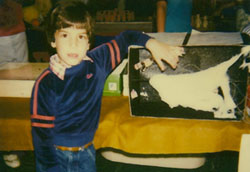
Craig’s Comet Project (May 1985)
The Challenger tragedy shook me, but it didn’t dim my view of space. Or at least my parents didn’t let it. Four months later, in April 1986, they woke me up at midnight to catch a rare glimpse of Halley’s Comet. (Midnight was so far past my bedtime that my mother made me go to sleep first and wake up when it was time to go.) We drove up Mill Mountain (home of our closest star) to the Blue Ridge Parkway — favored by amateur astronomers because it’s shielded from the lights of the city. There, along with other lucky children whose parents had gifted them with the experience, I glimpsed the elusive iceball and its fuzzy tail.
As the New York Times put it, “If a 10-year-old child is old enough to understand what he or she is viewing and remember it, that child will be 86 years old when the next opportunity knocks, around 2062.” This eight year-old child definitely understood and remembered it. Not only had I done a project on comets the year before, but I even snapped a photo of Halley’s to document the sighting.
Periodic Excitement
Odyssey Magazine (1987)
My photo wasn’t quite worthy of publication, but I got to see many others that were. Thanks again to my parents, I was a proud subscriber of Odyssey Magazine, a space magazine for young readers. Each month, I would eagerly await the next issue’s coverage of all things space.
In addition to the fascinating photos and articles, Odyssey also subtly reinforced the idea that there were other kids out there who loved space. By the time I got to fourth grade, I was already two years younger than my classmates. My small size, Yankee “charm,” and nerdy demeanor resulted in a lot of teasing and some outright bullying. I think it probably helped me stay the course to know that not only was it okay to like science, but there was an entire industry out there to support kids who did.
Although I never got to go to U.S. Space Camp as a child, its mere existence was another similar sign. It’s fitting that the program grew out of a 1977 observation by Dr. Wernher von Braun, the father of modern rocketry, that “We have band camp, football, cheerleading; why don’t we have a science camp?”
Simulated Space, Real Learning
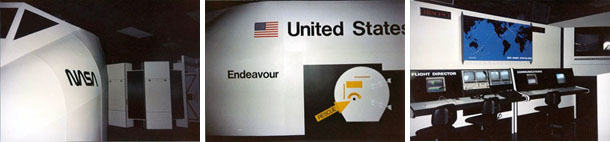
Addison Middle School Space Shuttle Simulator, featuring an orbiter and airlock to Skylab; orbiter crew hatch; and Mission Control (1993)
Roanoke was an early adopter of the magnet school concept. By creating compelling themed schools in inner-city locations that were open to students across the city, the district gave children unique opportunities and avoided racial segregation. One such success was the Lucy Addison Aerospace Magnet Middle School.
The highlight of the school was a Space Shuttle simulator, complete with mockups of the brand-new Endeavour‘s flight deck and crew quarters; the space station Skylab, and an airlock connecting the two. There was also a complete Mission Control center, with authentic stations and displays, and a planetarium. Space themes were integrated throughout the daily curriculum, but students could also participate in overnight mission simulations.
I was already in high school by the time the program opened, but I was fortunate to have had a chance with my friend Rusty (owing to our apparent reputation across the school system as a computer nerds) to help setup and maintain the dozen or so computers throughout the complex. I have fond memories of crawling on my back beneath the flight deck floor to attach monitor cables, testing the audio equipment in Mission Control, and running the LaserDisc videos that simulated liftoff through the flight deck windows.
Missile While You Work
![[Photo of Jupiter Missile]](http://www.fifer.net/blog/wp-content/uploads/JupiterMissile-061398.jpg)
Jupiter Missile in Wasena Park, June 1998
“The Rocket” was a PGM-19 Jupiter medium-range ballistic missile, which served as part of America’s nuclear arsenal in the 1950s and 1960s. It was the same type of missile on which monkeys Miss Able and Miss Baker became the first American animals to be launched into space and recovered alive. After the Jupiters were decommissioned, the military made them available to museums around the country. The newly-opened Virginia Museum of Transportation acquired one in 1965, transported to Roanoke by rail from the U.S. Army’s Redstone Arsenal. The transfer was shepherded by Jim Trout, a Norfolk Southern railroad employee who was elected to city council three years later. The missile was displayed in the museum’s collection in Wasena Park along the Roanoke River, among other items such as locomotives and airplanes.
On Nov. 4 and 5, 1985, the river rose 23 feet above its banks during the worst flooding in the city’s history. Much of the museum’s collection was damaged or destroyed, and the entire facility was relocated to higher ground downtown. For lack of any convenient way to move it, the missile remained perched in the park for another decade. That’s when Jim Trout returned to public office, and was able to obtain funding to relocate the missile.
My first step was to determine whether the missile was in sufficient condition to withstand being moved. I contacted the Smithsonian’s National Air and Space Museum and arranged for a “rocket doctor” to give the old bird a checkup. The expert, a chemist specializing in the conservation of aviation artifacts, used a bucket truck to inspect the metal structure and pronounce it fit for one last flight. During a layover at a local metal shop (whose owner, Ralph Smith, would be elected mayor two years later), the missile was repaired and repainted according to the original paint schematics I located. By the end of the year, it was back on display next to the downtown museum. (More photos)
Degrees of Study
While an undergraduate at Virginia Tech in 1997 and 1998, I took two semesters of astronomy. Rather than the stuffy classroom version, however, I opted to take the eight credits through Virginia Western Community College, in Roanoke. Classes were held at the Science Museum of Western Virginia’s Hopkins Planetarium (where my father may have bought that little red telescope) and along the Blue Ridge Parkway (from which I had seen Halley’s Comet more than 10 years earlier). The professor, Britt Rossie, was a middle school science teacher whose enthusiastic and easy-going manner made complicated subjects accessible to students of all ages. Rather than focus on obscure math, he approached astronomy in terms of fundamental concepts and the connection between Earth and the universe beyond. Britt passed away the next year, but I’ll always be grateful to him for making that part of my college education a lot of fun.
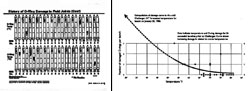
On the left is a chart by which NASA engineers decided to launch Challenger in 1986. The graphics show historical launch temperatures and O-ring damage. On the right are the same data, reformatted by design expert Edmund Tufte. The curve “shows increasing damage is related to cooler temperatures.”
Fast forward to 2005, and I had just started a master’s program at George Mason University. My first course, Introduction to Public Administration, focused on a variety of case studies to make important points about public management and programs. Our major assignment was to prepare and deliver a presentation on one of the studies, and I chose the one about the “butterfly ballot” in Palm Beach County, Florida, which may have cost Al Gore the presidency.
What does this have to do with space (aside from the fact that Palm Beach is the next county north of the Kennedy Space Center)? It turns out that many critics believe that the confusing design of a key chart used by NASA engineers obscured the link between cold temperatures and O-ring damage that was ultimately implicated in the loss of Challenger.
In both cases, an improvement in the design and presentation of information could have avoided disaster. My presentation looked at the ethics of decision-making by public officials when faced with imperfect choices, and the Challenger example was a surprising reminder. Having worked in public service since the age of 15, it was a wake-up call for me that seemingly simple decisions written off as mere aesthetics could have significant impacts on the people I’ve devoted my career to helping. As design expert Bruce Tognazzini put it, “Poorly constructed overhead slides don’t normally kill people, but they do often leave people in the dark.” Remember that as you prepare your next PowerPoint presentation.
The following year, for a course on program evaluation, I wrote a brief review of the U.S. Space Shuttle program as a whole. All evaluations since 2003 have been performed in the context of the Columbia tragedy, and the considerable introspection NASA gained from the Columbia Accident Investigation Board’s report. A mounting view by critics — including President George W. Bush and his Office of Management and Budget — was that the Space Shuttle program had become too expensive and too risky to continue.
This was the first time I had been forced to take an objective look at an institution I had always taken for granted as an obviously fantastic idea. It was also the first time I had to come to terms with the likelihood that the program would be ending one day soon. It was a sobering thought, considering that the Space Shuttle was the only way my generation has ever known space travel. After all, the first launch was just shy of my third birthday.
Childhood Dreams Come True
For better or for worse, the Space Shuttle’s days were numbered. Casual talk with friends about seeing a launch (“Yeah, we should totally go sometime!”) turned to more urgent inquiries into how to make it happen. In particular, my friend Chris and I often spoke of making the trip. In a stroke of luck that proved the value of networking, a mutual friend of ours wound up with a job at NASA that put him in a position to make our dream a reality.
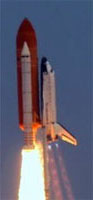
Launch of Atlantis on STS-125 (2009)
Chris and I attended the launch of Atlantis on STS-125 as guests of the NASA Administrator in 2009. It was an incredible experience; we were given VIP tours of the Kennedy Space Center, including the Vehicle Assembly Building, the Space Station Processing Facility, the Visitor Complex, the United States Astronaut Hall of Fame, and the Apollo / Saturn V Center. We stood stones’ throws from Atlantis on Launch Pad 39-A, and Endeavour on 39-B (although stone-throwing was strictly prohibited) — a rare opportunity to see two Orbiters ready for launch at the same time.
And of course, the launch. From our VIP viewing site at Banana Creek, we watched Atlantis lift into the heavens on a beautiful Florida afternoon. The launch was the brightest and loudest thing I’ve ever seen, and the most beautiful and awesome thing ever produced by the minds and hands of human beings.
One Small Tweep for Mankind
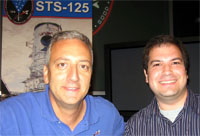
Craig with Mike Massimino, mission specialist on STS-125 and the first astronaut to tweet from space (2009)
I was hooked on NASA again. My time at the Kennedy Space Center helped balance the difficult political realities of the space program with a firsthand view — over and over again — of the incredible commitment shown by NASA’s employees and partners. I was deeply moved by the personal connection demonstrated by everyone associated with the Shuttle — and there were tens of thousands around the world. Everyone I met, from astronauts to assistants, knew that they were part of something special. What’s more, most of them would never actually have the chance to see what I saw, despite deserving to a lot more than me.
I knew I needed to help share what I had seen and learned, but I wasn’t sure how. NASA took care of that for me two months later, with an invitation to their second-ever tweetup. Held at NASA Headquarters exactly 40 years and 1 day after the Apollo 11 moon landing, it featured the crew of “my” mission. One member, mission specialist Mike Massimino, was the first person to send a tweet from space. I watched the crew give an overview of the work they did to repair and upgrade the Hubble Space Telescope, and answer questions from the audience. I was struck by how well each astronaut represented the space program, and how genuinely they believed in the value of space research and exploration. I got to speak with each member of the crew individually, and they each signed a photo I had taken of their launch.
I had only joined Twitter earlier that year, and I still wasn’t sure what I was supposed to be doing with it. The tweetup made me feel like an ambassador for NASA, with Twitter the vehicle I could use to deliver my impressions quickly and concisely. I got a chance to attend the next tweetup two months later, this time featuring the crew of STS-127.
From the Earth to the Spoon
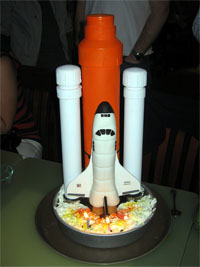
Space Shuttle cake for Craig’s birthday (2010)
By this time, I was talking space to anyone who would listen. That included my next-door neighbor, Olivia, with whom I had collaborated to create an Amtrak cake for my friend’s fifth birthday. Olivia, in turn, made an ambulance cake for my brother David’s birthday a few months later (he’s an EMT). When my birthday rolled around in April 2010, Olivia and David surprised me at a restaurant with an absolutely unbelievable Space Shuttle cake. The edible Orbiter was made from brownie covered in fondant; the orange External Tank and dual Solid Rocket Boosters were made from PVC pipe and held ice cream, chocolate syrup, and caramel sauce, respectively; and the brownie base was topped with whipped cream steam with color mist and sprinkles.
It was such a sight to behold that customers from other tables came over to take pictures. I was really touched that Olivia and David went to so much effort to conceive of and create such a wonderful gift, but I was also conscious of the fact that I was starting to become more and more publicly connected to the space program.
Another Launch and More Tweets
That connection paid off once more when I received an invitation to watch Atlantis fly again, on STS-132 in May 2010. It was another incredible experience, and I was able to see the launch from a slightly different angle (this time even watching the Solid Rocket Boosters fall back to earth after separating from the Orbiter). I also attended a panel at Georgetown University with the crew of STS-132, which, while not an official NASA tweetup, provided a similar level of interaction with the audience. I was again able to get the crew to sign a photo I took of their launch.
March 2011 provided an opportunity to attended my third and fourth NASA tweetups, just three days apart. One featured astronaut Doug Wheelock, the first person to check-in on Foursquare from space. He explained at NASA Headquarters how when he was first asked by NASA to engage in social media, he didn’t quite understand why. He said he was an engineer and test pilot at heart, but that tweeting from space helped him realize the human side of exploration. Ultimately, he realized that “If you’re choosing not to embrace social media, you’re choosing to be left behind in a global discussion that could really be life-changing for you.”
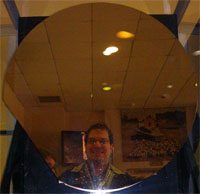
Craig reflected in a sample mirror panel from the James Webb Space Telescope, at Goddard Space Flight Center (2011)
These words really struck a chord with me. They demonstrated the power that social media has to connect people to each other without regard to location or station in life. I’ll expand on this in my next post.
Equally eloquent were Doug’s comments about the important of nurturing children’s dreams, which he called “a solemn obligation.” He noted that Neil Armstrong was once just a kid in elementary school, and that the first humans to walk on Mars might be in elementary school today.
The other tweetup that week was held at Goddard Space Flight Center, with a field trip to the National Air and Space Museum. The occasion was Sun-Earth Day, an annual celebration of the special relationship between the Sun and the Earth. The 13-hour tweetup included tours of Goddard and NASM that focused on the Sun, including an IMAX movie, a demonstration of solar telescopes, explanation of solar weather and Earth climate modeling, and much more.
This was also the first tweetup during which I had ample time to interact with my fellow space tweeps. Although I had gotten to know a few from previous tweetups, those events had consisted mostly of seated lectures, followed by a semi-orderly crush for autographs and photos. The Sun-Earth Day tweetup included lots of time on buses, walking between buildings, and sharing meals. I really enjoyed this aspect of the day, although I had no idea what level of engagement was in store for me with the STS-135 launch tweetup. But more on that in another post…
Around the Mall in 90 Days
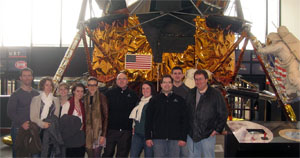
In front of an Apollo Lunar Module at the National Air and Space Museum (2011)
At the start of 2011, I made a new year’s resolution to visit every Smithsonian Institution museum and zoo over the course of the year. It turned out my friend DJ had made the same resolution, so we joined forces to invite our friends out each weekend. Gaining momentum, and wanting to beat the tourist rush in the Spring, we surprised ourselves by completing the challenge in just 90 days. Our quest resulted in 173 visits, by 63 people, and took us all over DC, into Northern Virginia, and to the two museums in New York City.
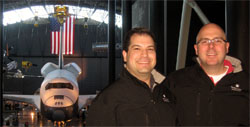
Craig and DJ, overlooking Space Shuttle Enterprise at the NASM’s Udvar-Hazy Center (2011)
Of course, this included the National Air and Space Museum’s main location on the National Mall, and the Stephen F. Udvar-Hazy Center in Dulles, Va. NASM was the first Smithsonian museum I ever visited as a child, and Udvar-Hazy just opened in 2003.
Among the many outstanding exhibits at both museums, I finally got to watch Hubble 3D, the IMAX movie filmed about the Hubble Space Telescope. Most of the movie was filmed at the launch of STS-125 (my first launch), and by the astronauts on board the Shuttle during the mission. Unfortunately, the camera stopped panning the bleachers where Chris and I were sitting a few feet before it got to us. Still, the movie is absolutely breathtaking, and tells an important story.
The Right Stuff
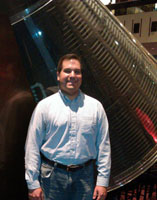
Craig with Friendship 7, aboard which John Glenn became the first American to orbit the earth (2011)
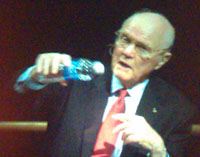
John Glenn uses a water bottle to demonstrate the flight of Friendship 7 (2011)
Last month, I was privileged to return to NASM for the third time this year, to attend a lecture by John Glenn and Scott Carpenter. As the only two living members of the Mercury Seven, they are unique bridges from the first moments of the Mercury missions to the last of the Space Shuttle missions. They spoke with candor and humor about the selection process, the barrage of tests to which they were subjected, and the complete unknown they faced on their missions.
Glenn, who turns 90 this month, said that education and research were what made America great in the early days of the space program, when “we learned the new things first.” He said he believes it’s a mistake to retire the Space Shuttle.
Carpenter, now 86, was particularly eloquent. He recalled how the most striking part of his launch on Aurora 7 in 1962 was going from blue skies to pitch black, and how the only thing more beautiful than the colors streaking by his window during re-entry was “the sight of a fully-inflated parachute.” When a young member of the audience asked him to name the most fun part of spaceflight, he answered “learning.”
I watched these American heroes while seated in chairs setup between the Friendship 7 capsule and the Apollo 11 command module, and directly underneath a scale model of Sputnik 1. It was truly surreal to see John Glenn standing in the same room as the ship that took him into space nearly 50 years earlier. Although I was not able to meet the astronauts, just seeing them in person helped complete a chain for me between the beginning of our country’s journey into human spaceflight, and the transition between chapters that I will witness later this week.
Up in the Sky
Minotaur 1 rocket launch from Wallops Island, as seen from Arlington National Cemetary (June 30, 2011)
Last week, I stumbled across a chance to see another rocket launch — although this one from over 100 miles away. On June 30, NASA launched the ORS-1 reconnaissance satellite on a Minotaur I rocket from the Mid-Atlantic Regional Spaceport. I happened to be driving home from pub trivia with my friend Rick, and we pulled over at Arlington National Cemetery to watch a tiny red dot hurl itself skyward. We could clearly see the stages separate, before the stage carrying the satellite disappeared into the clouds.
The International Space Station, as seen from DC (June 30, 2011)
Less than an hour before, Rick and I had stood on the roof of a bar in DC and watched the International Space Station zoom overhead. The outstanding Satellite AR app for Android told us exactly where and when the ISS would appear. As the brightest and fastest-moving “star” in the sky, it was easy to spot despite the city lights.
It’s still hard for me to believe that I can walk outside, look up at the sky, and clearly see something orbiting Earth because we put it there. It also provides an amazing point of reference for the Shuttle mission I’m about to see, which will dock with the ISS as part of STS-135.
The Story Doesn’t End Here
I’ve spent most of today writing this post. I didn’t intend for it to take this long, but I didn’t realize how much my path has crossed that of our space program, or how many emotions and memories I would stir while looking back. After 134 human spaceflights launched by the United States during my lifetime, and one more on Friday, it’s going to be a while before NASA sends someone to space in its own ship. It’s a fitting time for all of us to reflect on where we are today, and where we should go from here.
I believe in the value of exploration for its own sake. I believe that we can only realize our full potential as human beings when we follow our curiosity wherever it takes us. I believe in climbing mountains because they are there, not as a form of bravado or to demonstrate superiority, but because the unexamined life is not worth living. I believe there is something out there in the universe that we will be glad we found, even if we don’t yet know what it is.
For all these reasons, I am hopeful that America will continue its leading role in space research and exploration. On our 235th birthday today, we are at an uncertain point in our history with regard to this question. Many Americans don’t even understand it. Despite the fact that Americans spend more money each year on potato chips than on the Space Shuttle, many critics write off NASA as an extravagance. Despite the myriad of NASA inventions we use every day, many people think of NASA as merely performing abstract and obscure experiments. It’s time for us to recommit ourselves to the kind of dreams we once had.
My space story started with a little red telescope. Thanks to my parents, who have nurtured my dreams for my entire life, and thanks to the incredible people at NASA, whose passion makes the seemingly unthinkable a reality, I’ve grown up believing that anything is possible.
What’s your space story?
(Note: The “Rocket Dad” and “Missile While Your Work” sections were added on Jan. 17, 2014.)
Your blog is amazin! I feel smarter having read it.
[…] being granted a "backstage pass" to the launch is one Craig Fifer, an active tweep, space obsessive, and Alexandria's deputy director of communications. He and his fellow @nasa followers will be […]
[…] My Space Story […]
[…] being granted a "backstage pass" to the launch is one Craig Fifer, an active tweep, space obsessive, and Alexandria’s deputy director of communications. He and his fellow @nasa followers will […]